
Listen to This Article:
Culinary school can feel completely different from any classroom you’ve known, whether you’re coming straight from high school, returning with a college degree, or shifting from another career. It’s hands-on and fast-paced, a far cry from a traditional high school classroom or a crowded college lecture hall, so it’s natural to have a few questions about what to expect.
Before you commit or buy your first pair of houndstooth pants, it helps to understand what you’re signing up for: program options, timelines, costs, learning formats, and what the enrollment process looks like.
Understand Your Program Options
Culinary schools can offer a wide range of training paths. Auguste Escoffier School of Culinary Arts offers 11 different degree and diploma programs across six different disciplines, and before you begin, you’ll choose where to focus. Here’s a quick look at the programs you could study at Escoffier.
Culinary Arts
Culinary Arts is likely what most people think of when they picture “culinary school.” Escoffier’s Culinary Arts program can prepare students to pursue opportunities as a cook, a restaurant or food truck owner, or dozens of other careers.
Students can explore sanitation and food safety, cooking methods and knife skills, and culinary foundations. Depending on the program, courses can also help you understand the business side of the food service industry, with education in controlling costs and leadership.
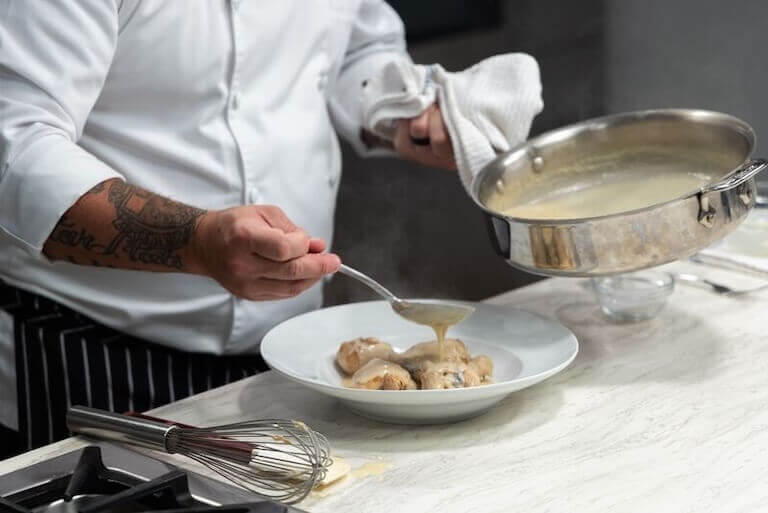
Culinary arts can prepare students for opportunities as chefs and more.
Baking & Pastry Arts
If you’re fascinated by the science behind the perfect loaf of bread or dream of row upon row of identical petit fours, then you may be interested in a Baking & Pastry Arts education, which focuses on baked goods like bread, cookies, cakes, confiserie, and more.
Similar to Culinary Arts, some Baking & Pastry Arts programs may include business education that can help graduates dive deeper by exploring topics like food and labor costs and principles of entrepreneurship.
Graduates of these programs might go on to become bakers, cake designers and decorators, chocolatiers, and more.
Plant-Based Culinary Arts
Plant-based cooking involves its own nuances and approaches, which is why Escoffier offers dedicated Plant-Based Culinary Arts programs. An education in ingredient substitutions, seasonal ingredients, and plant-based baking may help prepare future cooks and chefs for careers in vegan or vegetarian restaurants, catering companies, or private or personal chef roles.
For some people, plant-based education goes beyond career preparation and becomes a life-changing experience.* Mike Carrillo spent decades working in West Texas oil fields before a health crisis forced him to completely rethink his relationship with food. After developing Type 2 diabetes and reaching nearly 400 pounds, Mike ended up hospitalized with sepsis, scared he might not survive.
“I looked at my two sons . . . and in my head, I’m thinking, ‘What’s going to happen to them if I don’t make it through this?’ ” Mike recalls.
That moment led him to a diabetes reversal program focused on plant-based eating. In just three months, Mike dropped his A1C from 10.3 to 6.1 and eliminated all of his diabetes medications. Inspired by his transformation, Mike enrolled at Escoffier to deepen his understanding of plant-based cooking.
“I feel like diabetics need to know about this stuff,” he said. “I’ve been in their shoes, I understand how they feel.”
Today, Mike serves as Executive Director of Culinary Arts at Odessa College, where he’s designing programs to train the next generation of chefs. His advice? “In culinary, just like any other degree, you can make it anything that you want. … The world is your canvas.”
*Information may not reflect every student’s experience. Results and outcomes may be based on several factors, such as geographical region or previous experience.
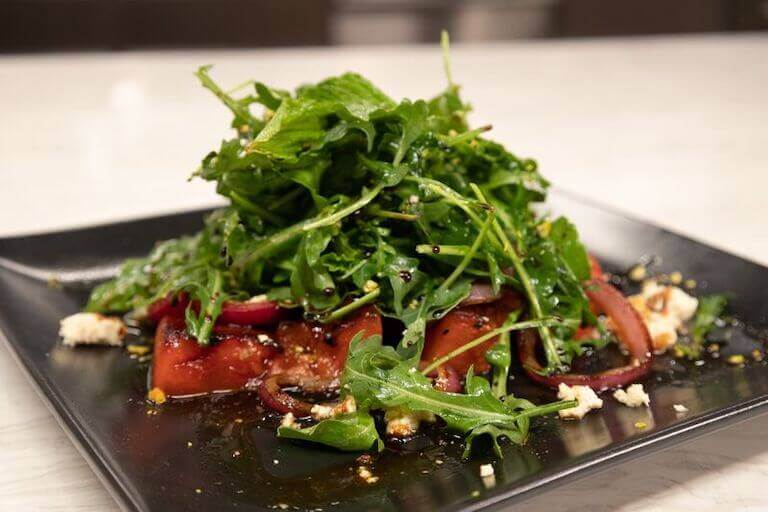
Plant-based dishes like grilled watermelon can showcase creative culinary techniques.
Holistic Nutrition & Wellness
Food can be deeply connected to our health and well-being, which is why pairing a culinary education with nutrition principles can be so valuable. Escoffier’s Holistic Nutrition & Wellness programs can offer that blend. Designed for those who want to become health coaches, holistic nutritionists, or health-focused chefs, these online programs can provide foundational knowledge in nutrition, coaching, and cooking.

Health coaches can encourage clients to take a balanced approach to health and wellness.
Hospitality & Restaurant Operations Management
The foodservice industry needs skilled cooks and chefs, but it also needs educated managers and operators who can bring everything together—the back of house, front of house, and all the little details that make a restaurant, hotel, catering company, or event venue run smoothly. Students can receive this type of training in Escoffier’s Hospitality & Restaurant Operations Management program.
With coursework in leadership and service, facilities operations, cost control and purchasing, and human resources, this program may help prepare students for a career as a hospitality manager in establishments ranging from restaurants to hotels to cruise ships.

The hospitality industry benefits from skilled managers who understand both operations and leadership in restaurants, hotels, and other establishments.
Food Entrepreneurship
Escoffier’s Food Entrepreneurship program aims to prepare aspiring culinary business owners for the challenges of running their own operation, combining coursework in marketing, foodservice management, and the culinary basics.
You Don’t Need Prior Experience to Get Started
Escoffier welcomes students from all backgrounds, whether you’re coming straight from high school, changing careers after decades in your field, or anywhere in between. What matters most is your passion for food and your commitment to learning. Many graduates started with little more than enthusiasm and a willingness to work hard.
Career changers often bring valuable transferable skills to culinary education. Take Mason Snyder, who served as an intelligence analyst in the U.S. Air Force before trying his hand at rodeo, where he earned the nickname “Cowboy Chef” for cooking meals for fellow riders on the road.
His analytical skills from military training helped him approach cooking with precision, while his farm upbringing gave him a deep appreciation for quality ingredients. When he decided to pursue culinary arts at Escoffier, Snyder chose the school specifically for its farm-to-table program, which aligned with his values.
Basic Skills That Help (But Aren’t Required)
While formal culinary experience isn’t necessary to enroll at Escoffier, some basic familiarity with cooking can help you feel more confident. If you’ve cooked for family, experimented with recipes, or even just watched cooking shows with genuine interest, this foundation can be helpful as you begin your culinary education. Regardless, culinary school curriculum typically begins with fundamentals.
If you’re nervous and want to build confidence before starting, consider:
- Practicing basic knife skills at home with online tutorials
- Following recipes exactly as written to understand precision
- Visiting local restaurants to observe kitchen operations
- Reading about food safety basics
Your Mindset Matters Most
Progress in culinary school and the industry tends to depend on a few key qualities: dedication, creativity, and a genuine desire to learn. The culinary world values hard work, attention to detail, and the ability to work under pressure. These qualities can be developed regardless of your starting point.
.
Remember, everyone starts somewhere. Even world-renowned chefs had their first day in a kitchen. What made the difference was their willingness to explore and their persistence in developing their skills.
Time Commitment & Credentials: Know What to Expect
The length of time it takes to complete your training depends on which program you choose and whether you’re studying for a diploma or a degree.
Diploma vs. Degree Programs
Diploma and degree programs follow different timelines, with diplomas taking between 30 and 60 weeks and associate degrees ranging from 60 to 84 weeks.
Associate degree programs include additional courses that can cover industry-related business management acumen, fulfilling general education requirements and helping students explore a broader set of topics.
What Does This Look Like in Practice?
You may spend your time in a mix of kitchen labs, coursework, and hands-on industry externships. Escoffier offers both on-campus programs and online programs, giving you the option to complete your coursework from home while still getting professional kitchen experience.
For Working Students
The flexible online format can allow you to study around your current job schedule; you’ll want to plan for 15-23 hours of school related activities each week, depending on program, credential and personal pace.
What to Know About School Format and Fit
Making a smart decision about the school you want to attend can have serious implications for your future career.
What Should You Look For in a Culinary School?
Start with experienced Chef Instructors. Look for instructors with both education and professional experience. Escoffier’s Chef Instructors include executive chefs, business owners, cookbook authors, and Certified Executive Chefs®.
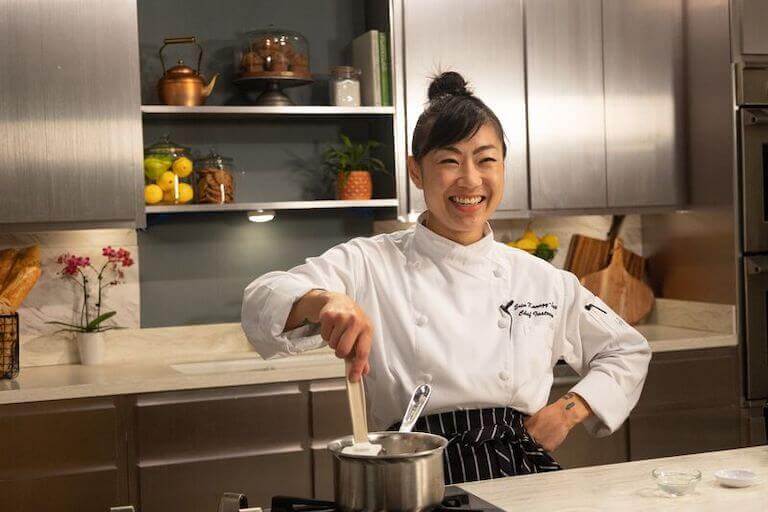
Chef Instructor Erin Kanagy-Loux brings a wealth of professional experience to her role teaching Pastry Arts online.
You should also consider the school itself—is it a community college or a larger university that has dozens of majors? Or is it a school that focuses solely on culinary?
For Chris Puga, choosing the right school meant stepping outside of his comfort zone. Growing up in El Paso, Texas, Chris had dreamed of culinary arts after watching Emeril Lagasse on TV as a child. When it came time for culinary school, he made the bold decision to leave Texas for the first time to attend Escoffier in Colorado.
“If I’m going to take a leap, I’m going to take a leap,” Chris said. At Escoffier, he didn’t just attend classes—he threw himself into the complete experience.
“I would volunteer for everything … I wanted every chef there to know my name,” he said. His commitment to his studies and investment in the school community helped Chris become an Executive Pastry Chef by age 22, a goal he had originally set for age 45.*
Also consider accreditation. Accreditation shows that a school has met certain standards of education and quality, as verified by a third party, and accreditation is a prerequisite for a school’s ability to offer financial aid.
Escoffier’s Boulder and Austin campuses are each nationally accredited. Auguste Escoffier School of Culinary Arts in Austin, Texas, is nationally accredited by the Council on Occupational Education (COE). Auguste Escoffier School of Culinary Arts in Boulder, Colorado, is nationally accredited by the Accrediting Council for Continuing Education and Training (ACCET).
*Information may not reflect every student’s experience. Results and outcomes may be based on several factors, such as geographical region or previous experience.
Campus vs. Online: Understanding Your Options
Culinary education is no longer limited to a single format. Escoffier offers both campus and online programs, giving students more flexibility in how and where they train.
Campus Learning Traditional campus programs offer daily access to commercial kitchens, instructor feedback, and peer collaboration. Students can work with professional-grade equipment in restaurant-style environments. Escoffier’s campuses are located in Austin, Texas and Boulder, Colorado.
Online Learning Through Escoffier’s online culinary school programs, students can get their education in any of our programs from their own homes. Online culinary education has grown far beyond basic video lessons. The online culinary curriculum at Escoffier includes live and archive video class sessions, cooking demonstrations, reading assignments, cooking theory lessons, and hands-on cooking assignments. As long as students meet their weekly program deadlines, they can complete this coursework whenever it’s convenient for them.
Real-World Experience
Both online and campus students at Escoffier complete hands-on industry externships in professional settings. Career Services can help students with externship opportunity searches based on your location and career goals.
Choosing What Works for You
Consider your schedule flexibility, learning style preferences, relocation ability, and career timeline when deciding between formats. Both can lead to the same career opportunities when combined with dedication and practical experience.
What the Enrollment Process Requires
Enrolling in culinary school is a pretty straightforward process at Escoffier. Fill out an information request form online, then you can complete an initial interview over the phone to discuss your goals with our Admissions Department.
Next, you’ll fill out an application form. You’ll also have to submit some additional documentation, like proof of high school completion or equivalent. This could be a high school diploma, equivalency exam, or state-approved home school certificate of completion.
While you work through this process, you can also connect with the Financial Aid department to get your federal aid package if you apply and qualify, and start applying for scholarships.
There are a few additional steps in the process, but this is the basic “how to” for enrolling in culinary school at Escoffier.
What Culinary School Really Costs—and How to Plan for It
Before you enroll in culinary school and commit yourself to the financial investment, you should have a clear understanding of the program costs and what resources are available to you.
What’s Included vs. What You’ll Need to Purchase
When planning your culinary education budget, tuition is just the starting point. Understanding the complete investment can help you plan properly and potentially avoid surprises.
What Escoffier Provides All Students
Your program can include a comprehensive toolkit with professional-grade equipment: chef’s knives, digital thermometers, measuring tools, specialty utensils (like pastry bags and decorating tips for baking students), and your official Escoffier uniform.
What online students need to factor: You’ll need to supplement your home kitchen with basic cookware and purchase ingredients to complete assignments. Budget for home kitchen enhancement, depending on what you already have.
For campus students: Factor in living expenses in Austin or Boulder, plus transportation and personal supplies.
Other Costs to Consider
Beyond the obvious expenses, consider your situation and resources to determine what is affordable for you. Some students need to account for reduced income during intensive study periods, childcare during externships, or transportation costs if attending a program in person.
Your Total Investment
While Escoffier’s total program costs vary, remember that the actual net cost is different for everyone, depending on your current life circumstances and what kind of funding you may receive.
*Information may not reflect every student’s experience. Results and outcomes may be based on several factors, such as geographical region or previous experience.
At Escoffier, federal financial aid is available to those who apply and qualify.** Plus, students may be able to secure culinary school scholarships and grants, which don’t have to be paid back.

Make sure to calculate all of your expenses when considering culinary school.
**International students are not eligible for Title IV financial aid.
Keep Growing With Career and Alumni Support
The time you spend in culinary school is only part of your overall education. Escoffier’s Career Services team can help students with resume writing, interviewing, and job search support. EConnect, the school’s online employment network, can also help match career seekers with openings at top employers across the country.
*Information may not reflect every student’s experience. Results and outcomes may be based on several factors, such as geographical region or previous experience.
Graduates are also encouraged to build their professional networks with the Escoffier Alumni Association, an online platform that can provide a place to connect with other graduates and students.
What’s Next for You?
Now that you understand what to expect, you can make an informed decision about your culinary education. Remember, you don’t need prior experience to get started, and there are options to fit different schedules, budgets, and learning preferences.
Whether you’re drawn to the creativity of pastry arts, the innovation of plant-based cooking, or the business side of hospitality & restaurant operations management, culinary school can help you build the skills to pursue your goals in the food industry.
Ready to explore your options? Contact us to learn more about enrolling in culinary school.
To find out more, check out these articles:
- A Day in the Life of an Online Culinary Student
- The Highest Paying Culinary Jobs and Positions
- Is Culinary School Necessary to Be a Chef?
**Tuition rates are subject to change. Check Escoffier’s Tuition & Fees page for up-to-date information.
***For complete admissions requirements visit our catalog.
This article was originally published on November 18, 2022, and has since been updated.