
Listen to This Article:
In a few kitchens around the world, robot arms are flipping burgers, stirring sauces, and plating sushi with laser precision. AI-powered ovens adjust temperatures by the millisecond, and smart fridges reorder ingredients before you notice they’re gone.
The tools of tomorrow are already here. In 2025, 79% of U.S. restaurants use some form of artificial intelligence, and 96% of kitchens rely on automation for inventory management, food safety, or performance analysis. In quick-service restaurants, 51% of tasks are expected to be automated, while full-service venues are moving toward 27% automation. The global AI kitchen market is projected to expand by over $48 billion from 2025–2029, growing at 21.7% annually.
The shift is real, and it’s happening fast. So if you’re considering culinary school in an age of algorithms and automation, you’re probably wondering: what will my role be in this new kitchen? The answer lies in understanding both what cooking actually requires and how AI can amplify your capabilities rather than replace them.
Let’s explore six irreplaceable human elements that define culinary work and how technology might enhance, rather than eliminate, your creative potential.
#1: The Irreplaceable Senses: What No Algorithm Can Feel
As chef Alain Passard, the three-Michelin-starred visionary behind L’Arpège in Paris, puts it: “When you cook, you have to feel it. And what you feel goes into the food.”
A perfect dish depends on things no algorithm can feel. The scent of browning butter. The resistance of dough under your hands. The pastry chef who can tell by touch that butter is exactly 60°F for laminating dough. The line cook who hears a subtle change in risotto’s sound and knows it’s time for the next ladle of stock. The chef who tastes a broth and immediately knows it’s been simmering too long.
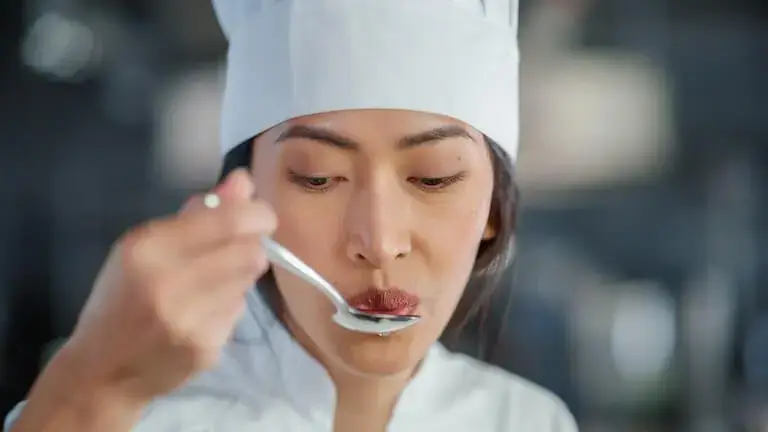
Taste remains the ultimate test — a skill no algorithm can replicate.
These skills aren’t in any recipe database. They’re honed through thousands of hours of practice, developing what researchers call “sensory memory”—the ability to recall and compare sensory experiences over time.
Consider what’s happening when you pull a spoonful of stock to your lips. You’re tasting, yes, but you’re also cross-referencing every soup you’ve made before. Is it as rich as last week’s batch? Does it need more salt, or is the flatness coming from lack of acidity? Your tongue, nose, and memory are working together, processing variables no sensor can measure. You’ve tasted thousands of things, and your brain has built a vast, interconnected map of flavor, aroma, and texture. When something tastes “off,” experienced chefs don’t consult a database—you know, the way a musician knows when a song is slightly out of tune.
AI can analyze molecular compounds and suggest pairings. IBM’s Chef Watson became famous for recommending unexpected ingredient combinations based on shared chemical structures (some good, like caviar and white chocolate, some bad, like an orange-and-cinnamon flavored burrito). These experiments were conducted in 2014, and while the project has since been discontinued, advances in machine learning mean that modern systems could, in theory, make more refined pairings today.
Here’s where collaboration gets interesting: AI can rapidly generate dozens of potential flavor combinations based on chemical analysis, giving chefs a creative springboard. But the chef still tastes, adjusts, and decides. Think of it as expanding your palette of possibilities: AI offers suggestions, but your senses make the final call.
AI can’t yet tell you that this blue cheese, aged three weeks longer than usual, will overpower everything else on the plate. It can’t account for summer tomatoes tasting different than autumn ones, or that the olive oil you just opened has an aggressive peppery bite throwing off your vinaigrette.
Professional chefs make dozens of micro-adjustments during service based on real-time sensory feedback. These aren’t conscious calculations from a computer; they’re reflexes built through repetition, attention, and mistakes.
#2: Creativity and Serendipity: When “Mistakes” Become Masterpieces
Some of the world’s most beloved dishes exist because someone burned something, dropped something, or simply refused to throw away a mistake.
In 1889, at the Hôtel Tatin in France, Stéphanie Tatin was making an apple tart when she realized she’d started cooking the apples in butter and sugar without laying down the pastry first. Rather than start over, she placed the pastry on top of the caramelized apples and flipped the whole thing after baking. The result—tarte Tatin, with its glossy, deeply caramelized apples—became an instant hit and is now one of the most classic desserts celebrated in French cuisine.
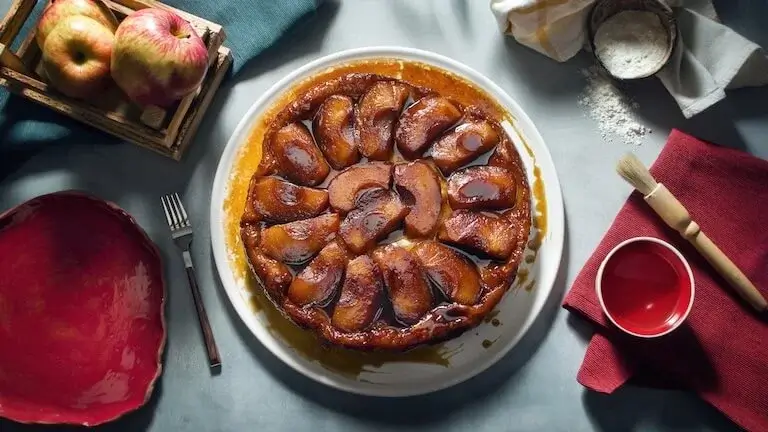
Some of the world’s most beloved dishes began as accidents, like the tarte Tatin.
Or consider the potato chip, born from spite. In 1853, chef George Crum at Moon’s Lake House in Saratoga Springs grew frustrated with a customer who kept sending back his fried potatoes, complaining they were too thick. In retaliation, Crum sliced potatoes paper-thin, fried them to a crisp, and salted them heavily. The customer loved them. An entire industry was born from one chef’s irritated improvisation.
Then there’s chocolate ganache, supposedly created when a clumsy apprentice in Paris accidentally poured hot liquid into a bowl of chopped chocolate. His chef reportedly shouted “Ganache!” (French for “jowl” or “imbecile”), but when they tasted the silky mixture, they discovered it was perfect for glazing cakes and filling truffles. The “mistake” became a cornerstone of French pastry.
These moments share something AI fundamentally lacks: the willingness to embrace chaos. Algorithms are designed to avoid error. They don’t get flustered and forget to add the pastry crust. They don’t act out of spite or frustration. They don’t taste a mistake and think, “Wait, this is actually brilliant.”
Yet AI can help you experiment more boldly. Modern chefs use generative AI to brainstorm variations on classic dishes or to explore “what if” scenarios, like what if I combined these three unlikely ingredients? The machine generates possibilities; the chef’s intuition recognizes which ones have potential. It’s like having a tireless brainstorming partner who never runs out of ideas, even if most of them need your human judgment to become something real.
In 2024, chef Grant Achatz, best known for Alinea, made headlines by letting AI design the entire menu at his Chicago concept restaurant, Next. Using ChatGPT, Achatz fed the system parameters, like seasonal ingredients, cooking techniques, his restaurant’s philosophy, and let it generate dish concepts. The result was a menu that surprised even him, pushing boundaries he might not have explored on his own.
But here’s what matters: Achatz didn’t blindly execute AI’s suggestions. He tasted, refined, and ultimately decided what made it to the plate. The AI generated possibilities; Achatz’s decades of experience recognized which ideas had genuine potential. As he explained, the technology offered “a different perspective,” sparking creative directions he wouldn’t have considered, but the final dishes still required his judgment, technique, and taste.
Cooking invites improvisation, and culinary innovation depends on human playfulness (and perhaps a few mistakes along the way). In that messy, unpredictable process, discovery happens. And while AI can suggest directions, only humans can recognize the magic in the unexpected.
#3: The Story on the Plate: Food as Memory
When Massimo Bottura created “The Crunchy Part of the Lasagna” at his three-Michelin-starred Osteria Francescana, he was nodding to universal Italian childhood memories of trying to sneak the coveted crispy edges of your nonna’s Sunday lasagna. Bottura learned to fold tortellini at his grandmother’s kitchen table, watching pasta sheets unfurl with flour-dusted fingers.
In New Orleans, chef Nina Compton named her restaurant after Compère Lapin, a mischievous rabbit from Caribbean folktales she read as a child in St. Lucia. Her menu tells the story of her childhood: curried goat she grew up eating, French techniques from her training, ingredients from the Gulf. Chef Serigne Mbaye brings Senegalese flavors and his mother’s techniques to Dakar NOLA. In San Francisco, Peter Fang built House of Nanking around Shanghainese home cooking, like dishes his mother made, ingredients from Chinatown markets, smells that still transport him back to childhood at 76.
At Atelier Crenn in San Francisco, Dominique Crenn turns her own memories into edible poetry. Each guest is greeted with a poem, and her “Story of the Sea” course layers oceanic flavors like oyster, caviar, and seaweed to capture the feeling of growing up near the coast of Brittany, creating a sensory memoir written through food.
These examples show that food carries meaning beyond flavor compounds. It preserves culture, can honor places and people, evoke memories—all things AI can’t do. However, AI can help you research and preserve culinary traditions, analyze historical recipes, or even connect flavor profiles from your heritage with modern techniques. The technology becomes an archive and research assistant; you remain the storyteller.
As a future culinarian, you might already be thinking about your voice. What’s your story? What memories shape how you taste? What culture, region, or family tradition do you carry forward? Your edge as a future chef won’t just be about technical skill. The food you cook has the potential to be an irreplaceable narrative only you can tell.
#4: Mentorship and Teamwork: The Rhythm Only Humans Can Keep
If you’ve ever stepped in a kitchen to shadow other chefs, or caught behind-the-scenes moments on shows like Netflix’s Chef’s Table, you’ll know that a well-run kitchen operates like a jazz ensemble. Everyone in the kitchen is improvising within structure, reading each other’s rhythms, adjusting on the fly. The head chef notices when a line cook is struggling. The sous chef steps in without being asked. The silent communication that happens during a rush when there’s no time for words, only glances and instinct.
AI can optimize kitchen workflows: automating schedules, monitoring equipment, predicting when to start prep based on reservation patterns. This can free up experienced chefs to focus on what matters most, like leading. When you’re not bogged down in manual scheduling or inventory spreadsheets, you have more energy for mentorship. AI handles the logistics so humans can handle the humanity. But the core of kitchen culture remains irreplaceable. AI can’t mentor a line cook who’s losing confidence. It can’t read body language to know when to push harder or ease up. It can’t build the team culture that makes people want to show up for weekend shifts.
The brigade system, developed by Auguste Escoffier and still used in professional kitchens today, thrives on human intuition. The saucier needs to sense when the garde manger is behind. The expeditor must read the dining room’s energy and adjust timing accordingly. The chef de cuisine has to lead, correct with kindness, and inspire creativity under pressure.
Leadership in kitchens requires conflict resolution, morale management, and the ability to shape raw talent into skilled cooks. As automation handles repetitive tasks, these irreplaceable human skills become more valuable, not less.
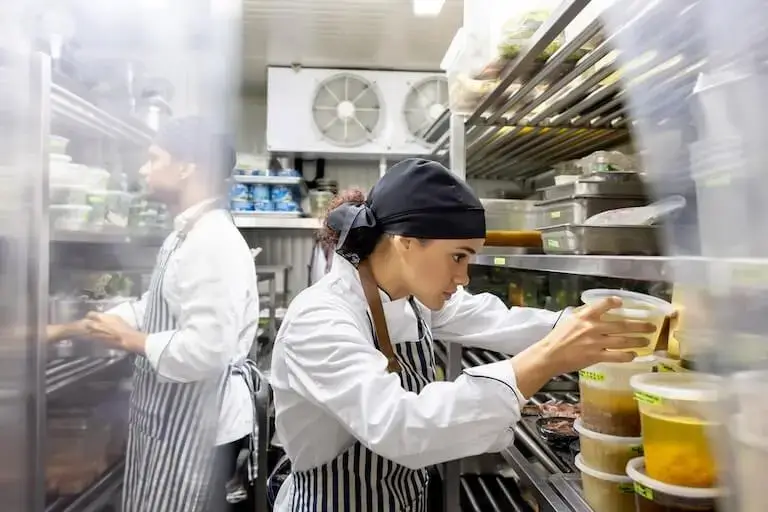
A kitchen moves like a jazz ensemble—guided by teamwork, rhythm, and trust.
#5: Emotional Intelligence: Reading the Room, Not Just the Recipe
Restaurateur Danny Meyer built his empire on a simple realization: “As good as our food was…what we really knew was that the way we were making people feel was even more powerful than what we were putting on the plate and in the glass,” he said. That’s hospitality at its core: the ability to read people, anticipate needs, and respond with empathy.
Great chefs, front of house teams, and restauranters don’t just focus on the food. They read the dining room’s energy. Is this a celebration or a difficult conversation? Does this guest want recommendations or space? Will Guidara, author of Unreasonable Hospitality, shares wisdom from Richard Coraine, a legendary restaurateur and mentor: “One of Richard Coraine’s most often repeated sayings was ‘One size fits one.’ He was referring to the hospitality experience: some guests love it when you hang out at the table and schmooze, while others want you to take their order and disappear. It’s your job to read the guest and to serve them how they want to be served.”
AI can analyze ordering patterns, predict popular dishes, and optimize inventory. It can even flag potential issues, like a table running behind schedule, a guest with multiple dietary restrictions, or a VIP reservation. This data empowers your intuition rather than replacing it. You get the insights; you provide the warmth.
But the human touch remains essential. AI can’t sense the unspoken tension at table twelve or know when a solo diner could use an extra moment of warmth. It can’t recognize that tonight, this particular guest needs comfort food, not innovation. Hospitality, in a way, is emotional labor. It requires empathy, intuition, and the ability to make people feel seen. As automation handles logistics, this irreplaceable human skill becomes the defining feature of exceptional dining experiences.
#6 Craft and Care: The Small Imperfections That Make Food Human
There’s a reason handmade pasta costs more than extruded pasta, or why artisan bread commands premium prices. The irregular holes in a naturally leavened loaf, the slight variations in hand-rolled gnocchi, the uneven char on vegetables tended by human hands—these are evidence that someone made this, not a machine.
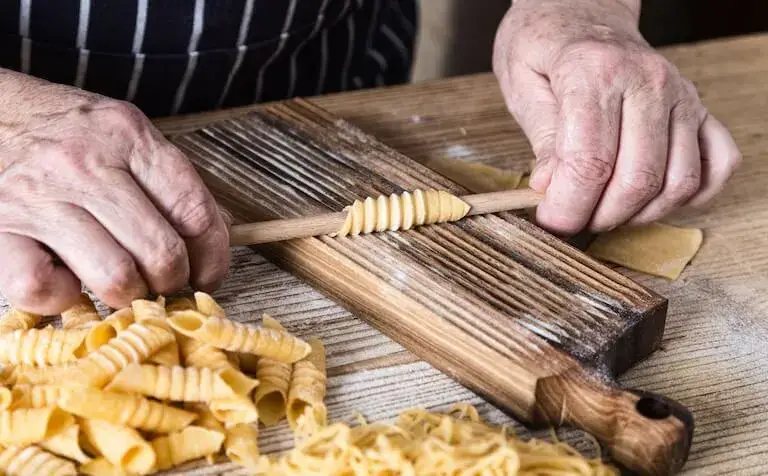
In a future shaped by machines, handcraft may become the true mark of skill
Robotic systems can achieve perfect consistency: every slice exactly the same thickness, every portion precisely measured. And for high-volume operations, this has value, especially given that restaurants often run on razor-thin margins. Smart chefs are learning to use both: let machines handle the repetitive prep work, freeing your hands for the touches that matter.
Handmade food offers something different. Think of how a hand-torn burrata catches olive oil differently than a machine-cut piece, or the charm of a dumpling with a slightly thicker pleat made by a family member. Craft isn’t about rejecting efficiency, it’s about knowing when precision matters less than personality. When you hand-roll pasta even though a machine could do it faster, you’re making a choice about what kind of food you want to make and what story you want to tell. Craft is also knowing when to let technology handle the mundane so you can focus on the meaningful.
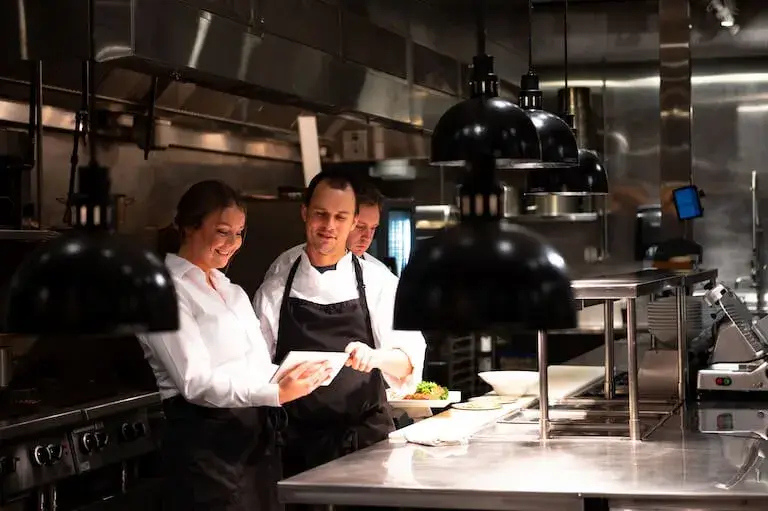
Technology supports the process, but mentorship, collaboration and true culinary skills keep the kitchen thriving.
Augmented, Not Replaced: Your AI-Enhanced Kitchen
The future kitchen won’t be human or machine. It will most likely be both, working in tandem.
Take a moment to imagine what a potential shift could look like. You arrive and check an AI dashboard that’s analyzed last night’s service.
It suggests scheduling an extra line cook tonight because a large party just booked, and it flags that you’re running low on key ingredients based on predicted orders. It shows that the short rib special sold out by 8 PM yesterday, and that Brussels sprouts have been moving slower than usual this week. Armed with this information, you adjust. You call in backup for the rush. You reorder stock before you run out. You consider swapping the Brussels sprouts for a different side, or you brainstorm with your team about how to make them more appealing. You add more short rib to tonight’s prep list.
The AI gave you the pattern. You made the decisions.
This is collaboration in action: AI handles data analysis, pattern recognition, and routine tasks. You bring taste, judgment, cultural knowledge, and the ability to read both your team and your guests. Technology can suggest that miso and butterscotch share certain flavor compounds, but you’re the one who decides if that pairing tells a story worth serving. AI can schedule your staff efficiently, but you’re the one who notices when someone needs a day off before they burn out.
The chefs who thrive in the coming decades won’t be the ones who reject technology or the ones who let it make every decision. They’ll be the ones who understand what each does best—and use both strategically. Let AI optimize your inventory and generate creative prompts. But you taste the dish. You lead the team. You make the food mean something.
Building Your Culinary Future
Throughout this article, we’ve explored what makes culinary work irreplaceable: sensory judgment, creative thinking, cultural storytelling, emotional intelligence, and craft. These are the capabilities that culinary education develops, the ones that separate someone who follows recipes from someone who truly cooks.
Technology will continue to evolve, and the tools in professional kitchens will grow more sophisticated. But the core of the craft remains unchanged: creating food that nourishes, delights, and connects people.
The kitchen of tomorrow may hum with sensors and algorithms, but it will always depend on chefs who can taste, imagine, and care. If that’s the kind of work you want to do, culinary school might be your next step.

