

Listen to This Article:
Daniela Peregrina measures her life in centimeters. At 54, she’s spent years bridging cultures—from her Serbian and Mexican roots to decades spent teaching languages, and now to the kitchen, where she transforms global flavors into innovative plant-based dishes.
Ask how she finds the courage to keep reinventing herself, and she’ll show you something unexpected.
“I have a tape measure that I have marked at my age,” she says. “I do it on the centimeter side. Let’s say if I were to live a hundred centimeters, a hundred years, I cut it right there.”
What remains is a stark visual reminder of the years she has left, assuming she lives to 100.
“Where am I at right now?” she’ll ask herself, and “what am I going to do with that little piece of amazing, crazy opportunity that I have left?”
For Daniela, that answer involved three aprons, and three complete reinventions of herself.
The Believe Apron
The first apron came from a stranger. Walking into a German bakery in her small California town of Tehachapi, Daniela noticed a woman wearing a tie-dye apron emblazoned with the word “Believe” and a purple dragonfly. All things she loved.
“I said, ‘Oh my gosh, your apron is gorgeous,'” Daniela recalls. “She takes off the apron, gives it to me, and says, ‘I’m going to give this to you because I’m being told that you need a sense of belief. You need to believe in your dream.'”
At the time, Daniela had spent 25 years as an ESL teacher, helping immigrant children and farmworkers learn English. She was born in the U.S. to a Serbian mother and Mexican father, surrounded by a mélange of languages (she’s fluent in five) and extraordinary food. Daniela recalls her Bosnian grandmother grinding nuts by hand for baklava, her mother baking fresh bread daily, and her own visions of a future culinary career.
“When I was a little, [like] a lot of little girls, we played cooks. We would cook with our dishes and such. In my head, I always thought I’d have this big kitchen,” she recalls.
And that’s because in her head she was not serving two or three people—she was serving hundreds at her own restaurant. But that culinary dream stayed tucked away through childhood and into adulthood, growing fainter with each year she spent in the classroom. By her fifties, it felt impossible.
“I kept telling myself that,” she says. “I’m too old.”
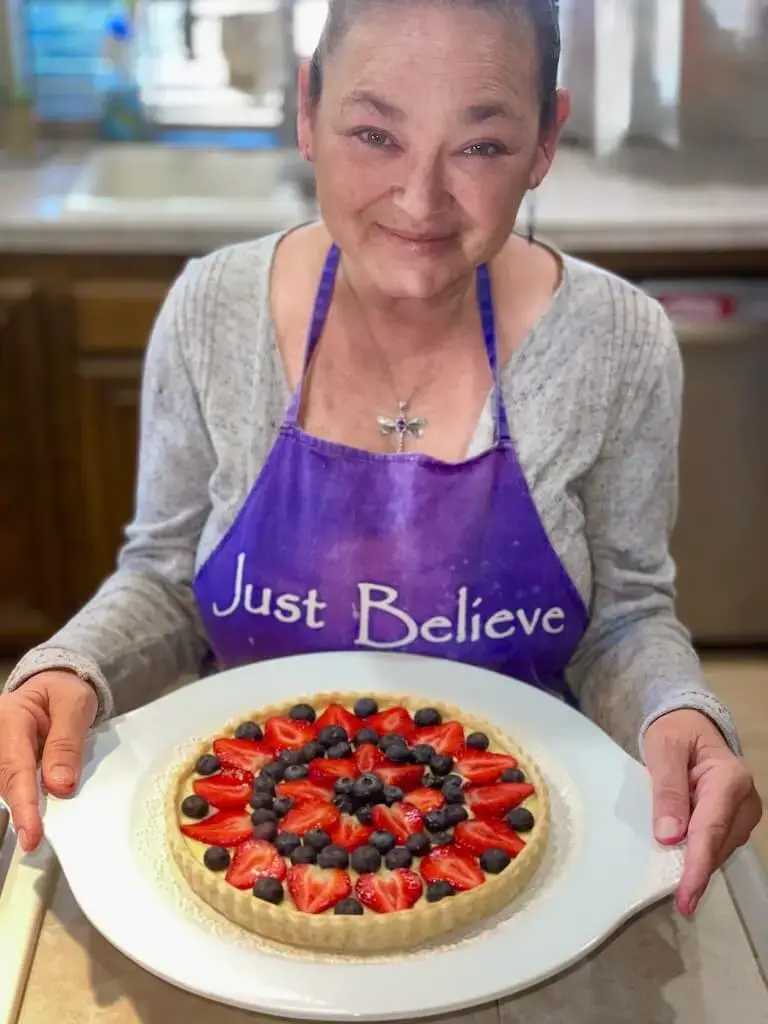
Daniela Peregrina wears the purple “Believe” apron a stranger gifted her and holds a berry tart she made as one of her audition dishes for MasterChef.
Through her decades teaching, she was also battling rheumatoid arthritis, an autoimmune disease that had left her bed-ridden two years earlier.
“I thought, ‘That’s it. I’m getting old. This is my life. I just have to accept it and make the best of it. I’ve lived a great life. I’ve traveled. I did great things, but it’s time for me to settle down and just get old.'”
But the apron and a simple act of kindness stirred something long dormant. The word believe lingered with her, a quiet reminder that maybe it wasn’t too late to begin again.
With this little nudge from a stranger, she felt a sudden inspiration to put her culinary skills to the test. When the opportunity to audition for MasterChef crossed her path, Daniela took the leap, filming her audition at home and wearing the apron like a talisman of possibility.
The MasterChef Apron
Daniela had actually applied to MasterChef a year before, for Season 13’s United Tastes of America, and made it far in the process before being rejected. Then, a year later, she got an unexpected call asking if she’d like to reapply for Season 14: Generations.
“I thought they were punking me,” she recalls.
The audition process was rigorous, pushing her to elevate her plating and technique through multiple rounds of at-home cooking challenges. Out of approximately 40,000 applicants, about 100 were flown to L.A., then narrowed to 40 who competed for aprons with their signature dishes. Only 20 received one.
Daniela’s audition dish was Chiles en Nogada, considered by many to be Mexico’s national dish. This dish was initially created by nuns to celebrate Mexico’s independence in the 1800s. According to legend, nuns who had sheltered the families of insurgent soldiers were asked by a victorious general to create a dish featuring the three colors of the Mexican flag. The Mother Superior and her sisters crafted this fall dish using seasonal ingredients from Mexico’s higher elevations: toasted poblano chiles filled with a mixture of dried fruits, plantains, peaches, apples, and pears, topped with a cream sauce made from peeled walnuts and goat cheese, then garnished with pomegranate seeds and parsley for the red and green.
“I was scared. I did not want to do that dish because I said, ‘They’re going to think this is crazy. There’s sweet. There’s sour. There’s spicy. There’s creamy. There’s smoky. There’s way too many flavor profiles in this,'” she remembers.
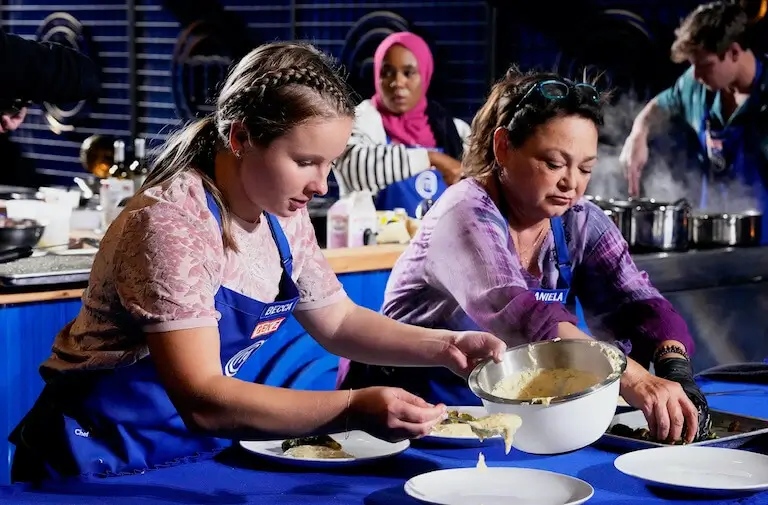
Daniela Peregrina, right, cooks during the first team challenge at MasterChef at the BMO stadium. Photo courtesy of FOX One.
To receive the apron and the opportunity to compete on MasterChef, three out of four judges must say yes to a contestant’s signature dish. For Daniela’s dish, all four judges, including Chef Aarón Sánchez and Joe Bastianich, said yes. When Joe discovered Daniela’s Serbian heritage, they even exchanged a few words in Serbian (his parents were born in the former Yugoslavia, now Croatia). With Aarón, she easily switched to Spanish.
During the competition’s Generation Box challenge, Daniela faced ingredients from Gen X childhood: Gatorade, cheese puffs, Cup O’Noodles, hot dogs. With 45 minutes to create an elevated dish, she ground the hot dogs with ginger and lemongrass, combined them with turkey to make meatballs, created a deeply flavored broth, and served it all with broccoli noodles and a poached egg.
“And–Bob’s your uncle–I served Gordon Ramsay hot dogs and ramen, and he liked it,” she says with evident pride.
But beyond the competition itself, Gordon Ramsay taught her something that would reshape her approach to life.
“Chef Ramsay would tell us, ‘Tomorrow’s another day. Shake it off. Go to bed. Get some rest.’ Then when we’d walk in the kitchen, he would say, ‘Today is a new day. Whatever happened before happened before. Let’s move forward. Today is a new day.’ I kept adopting that reset philosophy. Every day is a reset.”
Daniela finished 11th in the competition and still proudly wears her MasterChef apron, but only when it serves a purpose. She brings it out for community events like volunteering at food banks or helping at charity fundraisers, where its recognition can draw attention to a good cause.
“It’s a very special apron but also a very powerful tool to be able to open doors [and] be able to do that,” she says.
The Escoffier Apron
The MasterChef experience had been transformative, but it also left her reflecting on her own health. After weeks of cooking with rich, heavy ingredients and tasting through indulgent dishes, Daniela went in for a routine doctor’s appointment. Her cholesterol numbers were higher than expected.
The results were a wake-up call. Combined with her ongoing battle with rheumatoid arthritis, she knew something had to change in her approach to food.
“I said, ‘Well, if I’m going to do this, I’m going to do this right.'” She went cold turkey, eliminating all meat from her diet and transitioning to what she calls “plant-forward” eating rather than strict veganism. The change wasn’t just about cholesterol; it also helped manage the inflammation from her rheumatoid arthritis.
“If you have any type of inflammatory issues, plant-based is the way to go,” she says, acknowledging she’s become “the poster child advocate screamer on the soap box.”
The dietary shift did something unexpected: it transformed her into a culinary scientist. MasterChef had given her the confidence to experiment boldly. Now she needed to learn how to apply those skills to an entirely different way of cooking.
“Now I act like a mad scientist. I stare at things in my oven. I’m looking because I’m trying to replicate the flavors,” she explains. “For example, a dish that we make that has feta cheese and cream; how can I make that using cashews? It’s almost like playing in the kitchen and building flavors.”
Her exploration extended beyond substitutions to an entirely new world of seasonings. “I have three cabinets full of spices. I’m learning so much about the spices around the world,” she says.
Fellow MasterChef competitor Jeet Kaur Sawant became an unexpected mentor in this journey. “I have never met someone who has such a wonderful grasp of seasoning and texture,” Daniela says. “I’ll say, ‘How can I use cardamom in this?’—because cardamom is a part of my repertoire, having grown up in a European and Mexican tradition. She’d help me along with that.”
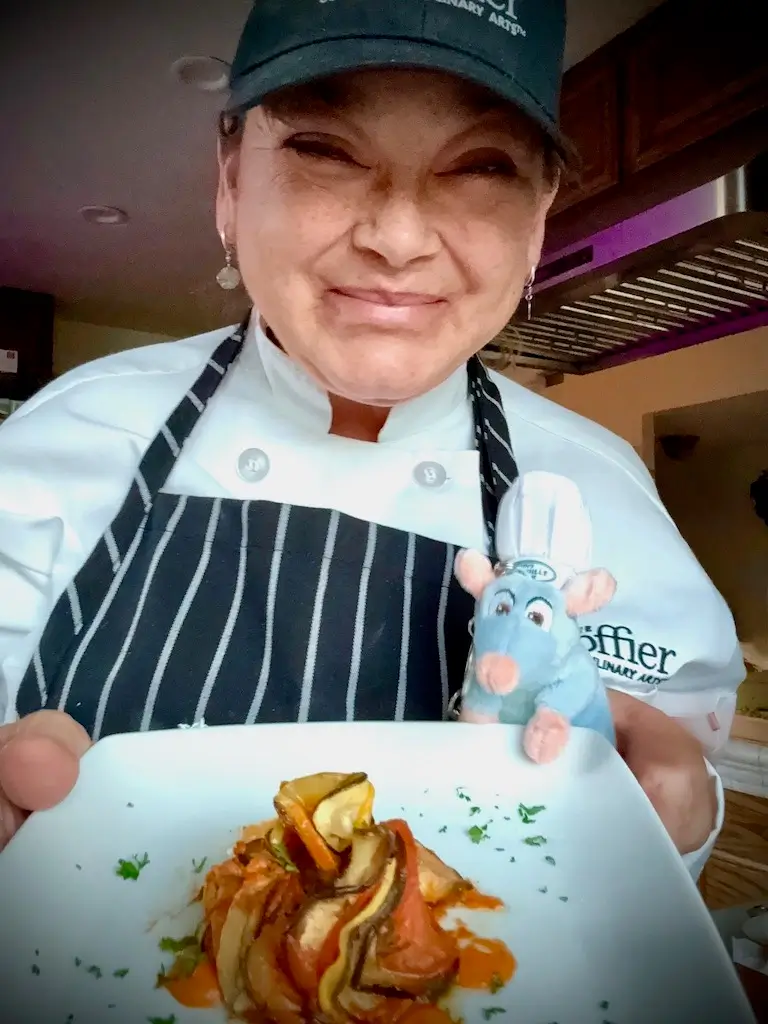
Daniela Peregrina continues reinventing herself, including studying plant-based cuisine at Escoffier.
This playful experimentation led her to Auguste Escoffier School of Culinary Arts’ online plant-based program. She had been researching plant-based and online schools when she came across Escoffier in the middle of the night, applying at 1 a.m., convinced she wouldn’t be accepted, but was.
The online format proved perfect for someone with a busy life who was also managing a chronic illness. “If I have a tough day where I can’t get out of bed, and I can’t function, and I can’t move, I can still be in class regardless,” she says.
Daniela was also worried that learning online might feel isolating, but found the opposite to be true. “That was one of the things that I thought was going to be a challenge being online on a Zoom, but I have actually been very blessed.
“I have a small little community of two other women who are in the plant-based program with me,” she says. Together, they cook alongside one another on Zoom, and share back-and-forth video messages on a video messaging app.
“My little community of three [says,] ‘Hey, you know, my cake fell apart’, or ‘This happened,’ or ‘My pie crust didn’t work. Can you help me?’ So we’re helping each other,” she recalls.
And one of her biggest surprises? Becoming a baker.
“I am not a baker. It’s so boxed and almost—well, not almost—it is very precise,” she admits. But with support from her chef instructors, particularly Chef Stefanie Bishop-Schmidt, she’s learned to love the science of baking.
Her banana bread breakthrough was revelatory. “It wasn’t that dense, almost moist type banana bread that I grew up with—which is delicious! It was light and fluffy and airy and crumby. I’m talking like a chef now,” she says with a laugh. “When I pulled that banana bread out, it was like I had painted the Mona Lisa.”
She’s even adopted professional habits, like labeling everything in her fridge with painter’s tape (she has the classic blue, but she’s worked purple into the rotation, too).
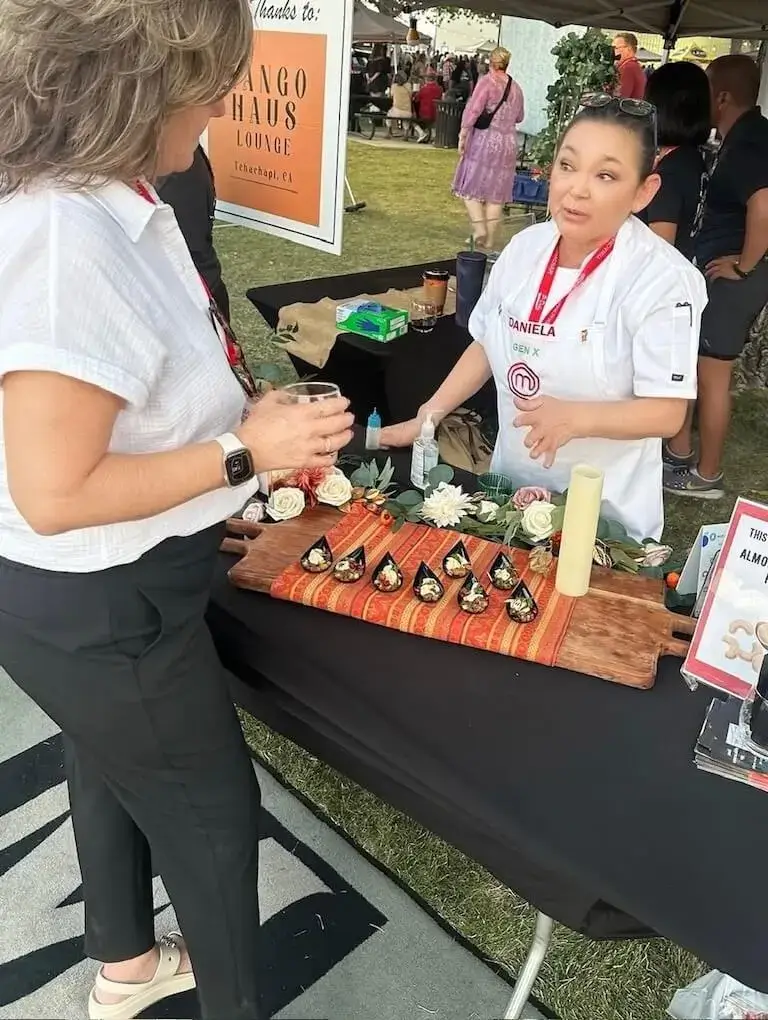
Daniela Peregrina speaks with an attendee at a local Tehachapi event called Cheers to Charity, where she served 350 small spoon appetizers inspired by the dish, Chiles en Nogada, for which she received her white apron on MasterChef.
All Three Aprons
Daniela sees her three aprons as chapters in an ongoing story. “One represents [that] you have to believe. You have to do what you want to do. Your dreams are valid. The other one represents the dream coming true, and the Escoffier is the possibilities of all the dreams that are to come.”
She graduated on July 1st, 2025, wearing her toque blanche. What comes next might be a small café, maybe even called Three Aprons. Or it might be something else entirely. She’s no longer constrained by the voice that said “too old.”
That tape measure still hangs nearby, each millimeter a reminder to keep showing up—for herself, and for the next dream waiting to be stitched together.
“How am I going to show up for each of these millimeters?” Daniela asks. “And I have to show up for me. Not for anybody else, but I have to show up for me.”
Wondering if it’s your time to reset? Contact us to discover how Auguste Escoffier School of Culinary Arts’ online programs can help you pursue your culinary passion, no matter where you are in life.

