

Listen to This Article:
Two students are working on the same fundamentals—one whisking sauces in a buzzing campus kitchen, shoulder to shoulder with classmates; another practicing the same techniques at midnight from their home stove, replaying the lesson until they’ve nailed it.
Both are future chefs honing the same craft, but the experience can look very different depending on where and how you learn. As more aspiring chefs seek flexible ways to train, especially when balancing work, family, and new career goals, online culinary education has become an increasingly popular path.
The question isn’t which option is better, but which one feels right for you. At Auguste Escoffier School of Culinary Arts, students can pursue their passion through online culinary arts programs or on-campus experiences in Austin or Boulder. Here’s how you can decide which format aligns best with your lifestyle, learning style, and career goals.
Which Format Fits You? Escoffier’s Online and On-Campus at a Glance
| Online Culinary Education | On-Campus Culinary Education | |
|---|---|---|
| Flexibility | Complete coursework on your own time during the course week; just meet deadlines. Ideal if you work, have children, or need to study at odd hours. | Fixed class schedule. Intense, immersive experience—requires commute and time on campus. |
| Learning Style | Guided independent learning, visual/virtual demos, autonomy in home kitchen; suited for self-motivated learners. | Immersive, in-person learning in a tightly structured schedule; may be suited for learners who thrive with a set schedule and face-to-face instruction. |
| Interaction | Virtual discussions groups, one-on-one feedback, some live and recorded sessions; less spontaneous peer interaction. | Face-to-face with instructors/peers in a shared classroom environment with hands-on group learning and a social classroom setting. |
| Externship/Career Goals | Hands-on industry externships can help prepare for professional roles. | Hands-on industry externships can help prepare for professional roles. |
| Farm to Table® | Part of some programs’ coursework, and optional immersion events | Part of some programs’ coursework, and optional immersion events |
| Technology Needs | Stable internet, a camera and computer, and basic kitchen equipment at home required; toolkit provided as part of total program cost. | All equipment/facilities provided on site; toolkit provided as part of total program cost. |
What the Culinary School Experience Really Feels Like
At Escoffier, both on-campus and online programs cover the same essential skills, like knife techniques, cooking methods, and menu planning, but the way you experience that education day-to-day can look very different.
On-Campus: A Day in the Kitchen
Escoffier offers on-campus programs at its Austin, Texas, and Boulder, Colorado locations, two cities known for their dynamic food cultures. Students in Austin might explore the city’s renowned barbecue, food truck, and farm-to-table scenes, while those in Boulder are surrounded by an environment that celebrates local sourcing and sustainability. Both campuses provide fully equipped professional kitchens, small class sizes, and direct access to chefs who bring real industry experience to every lesson.
Unlike traditional colleges where you juggle multiple subjects, Escoffier’s on-campus programs let you focus intensively on one to two classes at a time, diving deep into specific culinary skills rather than spreading your attention thin. Classes are intentionally small, and can give you more opportunities for personal attention and direct feedback from Chef Instructors. And it’s not just about individual skills; you can coordinate multi-course meals with classmates, learning to communicate, delegate, and support each other just like in a professional brigade.
Whichever campus you choose, the day begins with chef whites on, knives ready, and production sheets in hand. Students often spend multi-hour blocks in the kitchen, practicing knife skills, sauces, and plating while Chef Instructors move through the kitchen, offering quick tips and adjustments right at your station.
The buzz of clattering pans, the heat of the line, and the teamwork required to pull off multi-course meals all mirror the pace of a professional kitchen. It’s engaging, physical, and deeply collaborative.
From the Field: “Everybody made me seem like I was where I needed to be and that’s what I loved about being a part of Escoffier, and I will always be thankful for that.”* — Suki Herrera, Baking & Pastry Graduate
*Information may not reflect every student’s experience. Results and outcomes may be based on several factors, such as geographical region or previous experience.
Farm to Table®: Beyond the Kitchen
Escoffier’s on-campus culinary education extends beyond the teaching kitchen. Culinary Arts students at both Austin and Boulder campuses complete a 6-week Farm to Table® Experience, visiting local farms, ranches, and artisan producers to see firsthand how food is grown, raised, or crafted.
You might harvest seasonal vegetables, collect fresh eggs, milk goats and process dairy into cheese, or learn charcuterie from local artisans. Then, you may bring some of those ingredients back to the kitchen to create seasonal menus. These hands-on experiences can help shape how you think about sourcing, seasonality, and sustainability, skills that translate directly into professional kitchens.
Online: A Day in Your Own Kitchen
Online students, meanwhile, can approach the curriculum on their own schedule. Instead of commuting to a teaching kitchen, you log into your digital classroom, watch chef demonstrations, and then replicate those lessons in your own kitchen.
Escoffier’s online programs mirror the same course outcomes taught on campus, ensuring students gain a complete culinary education. Each online course is designed by subject matter experts, most of whom are Escoffier Chef Instructors. Through interactive platforms, video feedback, and one-on-one guidance, online students receive personal attention while working in their own kitchens.
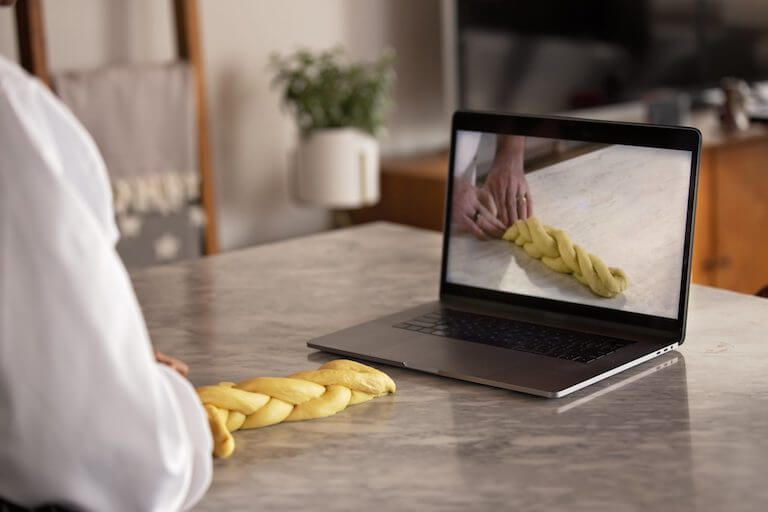
Online students log in from almost anywhere, fitting lessons into their own schedule.
After completing each assignment, students upload their work and photos online, where Chef Instructors provide personalized feedback. Online culinary school is more flexible with assignments due weekly, but can also require strong self-motivation as students plan grocery runs, document progress, and stay organized on their own without the structure of an on-campus schedule.
From the Field: “Their online program is top-tier, and the staff work tirelessly to support students because our success is theirs, too. I worked 60 hours a week as an employee while simultaneously running my business and keeping up with my personal life while attending this school.”* — Shamaya Williams Coats, Online Culinary Arts Graduate
*Information may not reflect every student’s experience. Results and outcomes may be based on several factors, such as geographical region or previous experience.
Online students can also join optional, in-person immersion events designed to complement your coursework with real-world practice. You’ll get your hands dirty with ingredient sourcing at local farms, ranches, orchards, vineyards, and artisan operations. These immersive events aren’t for credit, but they offer insight, connection, and unforgettable hands-on learning.
And when it’s time to take your skills from the home kitchen into a professional setting, Escoffier’s hands-on industry externships can help bridge that transition.
Externships: Where the Classroom Meets the Real World
Whether you’re whisking sauces on campus or in your home kitchen, every Escoffier student takes the same important step: completing a hands-on industry externship. This is where classroom skills meet the pace and pressure of a professional operational restaurant or related business. Externships can be a chance to test your abilities in a real workplace, work alongside experienced chefs, and build connections that could open doors after graduation.
Selecting your externship location can be an exciting opportunity to explore new options. Some students arrange placements close to home, like neighborhood bakeries, farm-to-table restaurants, or boutique catering companies, so the experience fits their daily rhythm. Others pursue opportunities at luxury hotels, fine-dining establishments, or even kitchens abroad, turning their externship into a culinary adventure.
In the final months of your online or on-campus program, Escoffier’s Career Services can help identify potential externship opportunities based on your goals and location. They can assist with resumes, portfolios, and interview prep, but it’s ultimately up to you to choose and connect with sites that align with your aspirations. Depending on your program, you’ll complete one or two externships with a commitment of 6-12 weeks.
Past Escoffier students have externed everywhere from celebrated restaurants like Yolan and Frasca Food and Wine to world-class hotels, including The Ritz-Carlton, Four Seasons, and the Biltmore Estate. Others have joined pastry teams in boutique patisseries, supported banquet operations at resort hotels, or learned production flow in specialty food shops.
By graduation, you’ll have gained real-world experience in a professional kitchen, plus you’ll have the potential to build professional references and the confidence that comes from proving yourself in the field.
From the field: “Without Escoffier insisting on that externship experience, I would still be a lone ranger, so to speak. But now, I have these array of chefs behind me that I can call upon at any one time, and they’ll come. We can work together. We’ve been exchanging ideas. We’ve kept in touch. We’ve exchanged recipes and know-how.”* — Bekei Ijewere, Escoffier Online Culinary Arts Graduate
*Information may not reflect every student’s experience. Results and outcomes may be based on several factors, such as geographical region or previous experience.
Building Community and Connections
While you’re busy learning valuable lessons in the kitchen, you also have the opportunity to build relationships along the way. Both on-campus and online education can help foster connections with instructors, classmates, and industry professionals that can shape your career long after graduation.
On a campus, networking can happen organically as you work shoulder-to-shoulder with classmates and get to know Chef Instructors who bring industry experience and professional connections to every lesson. Students can expand their networks by volunteering at local food festivals in Boulder or Austin, joining professional organizations, such as the American Culinary Foundation (ACF), and collaborating on projects and competitions.
Michael Fields, an Austin campus graduate, experienced this firsthand. When instructors recognized his talent for barbecue, they introduced him to Aaron Franklin of the legendary Franklin Barbecue. After a four-hour heat test in a 130-degree pit room, Michael was hired on the spot.
“Culinary school gives you the confidence you need to get in the door much more easily than if you were just to go work in a restaurant,” he said.
Online students might not share a physical kitchen space, but they’re not learning in isolation, either. Through Escoffier’s Club Hub, students can connect through interest-based groups, such as sourdough enthusiasts, pizza perfectionists, or plant-based explorers, share techniques and troubleshoot together. Online students can also build networks by attending local food events in their community, forming relationships during externships, and connecting with chefs and alumni on social media.
The food world is a tight-knit community, and the relationships you build during your program, whether online or on-campus, could open doors throughout your entire culinary career.
Your Learning Style Matters When Choosing Culinary School
Now that you have a better overview of what the online and on-campus experiences entail, you’ll also want to consider how you learn best. When deciding which format is right for you, think about how you absorb information, because your learning style can make all the difference.
Online Learning Styles: Pause, Replay, Reflect, and Communicate
Online programs can be a dream for visual and auditory learners. You can pause and replay a chef’s demonstration as many times as you need, watching how a roux transforms stock into a savory Velouté.
“Our online students are probably better at verbalizing what they’re doing and describing tastes,” says Chef Instructor Jesper Jonsson. “It teaches them to self-assess, rather than relying solely on outside opinion.”
And without the built-in rhythm of a traditional class schedule, online students must lean on self-motivation and discipline to stay on track. It’s up to you to plan your week, carve out practice time, and hold yourself accountable to deadlines. That independence can actually become a strength, sharpening your ability to self-assess and manage your time—skills that translate directly into professional kitchen life.
From the Field: “The online program is so detailed. When making your assignment, you have to take step-by-step pictures, there are Zoom sessions with great chefs, and study halls for demonstrations. I’ve learned so much online!”* — Danelle Esquivel, Online Culinary Arts Graduate
On-Campus Learning: Hands-On and Collaborative
If you’re a collaborative learner, the kind who learns best by working with others, an on-campus program may be your sweet spot.
Imagine plunging your hands into a bowl of focaccia dough, feeling how the gluten stretches and strengthens, or learning how it shouldn’t feel if something goes off track. In a shared kitchen, those teachable moments aren’t limited to your own station. Maybe a classmate nearby struggles with a sauce that breaks, and suddenly the whole group has the chance to see what went wrong and how to fix it. After all, it’s just as important to know what a broken sauce looks like as a perfect one.
If you learn by getting feedback in person, on-campus could be a good fit for you. In this format, a Chef Instructor might stop at your station, adjust your grip on the knife, or show you how a silky béchamel should coat the back of a spoon. Feedback like this is instant, and the energy of working alongside classmates mirrors the teamwork of a professional kitchen.
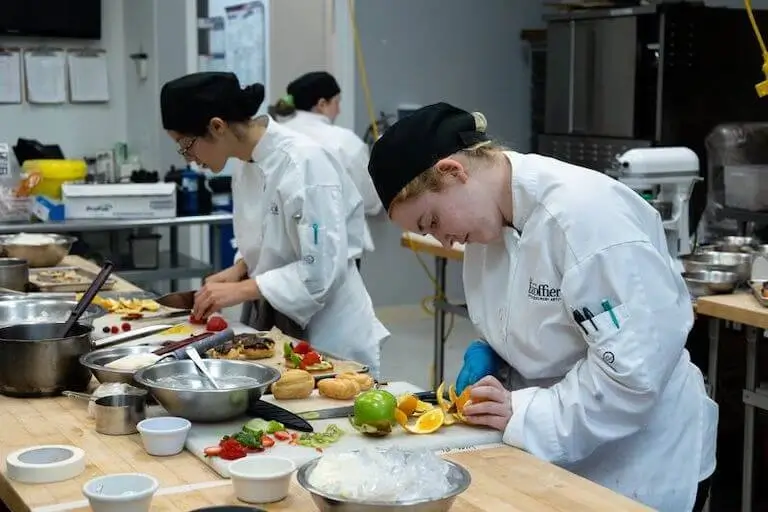
On-campus learners can get instant feedback from Chef Instructors during lessons.
How to Decide Which Format Is Right for You
Still unsure which format fits? Ask yourself:
- Do I prefer learning through touch and teamwork, or by reflection and repetition? On-campus students often thrive in collaborative, hands-on environments that provide timely feedback. Online students often excel with independent practice and the ability to replay lessons until they’ve honed each technique.
- Do I need a flexible schedule that fits around work or family? If you’re balancing a job, raising children, or managing other commitments, online learning lets you complete coursework on your own time as long as you’re meeting weekly deadlines.
- How important is in-person mentorship and immediate feedback to my learning style? On-campus students get timely adjustments from Chef Instructors during kitchen labs, while online students receive detailed feedback and guidance.
Both paths lead to the same destination: a comprehensive culinary education, hands-on externship experience, and the skills to help launch your career. No matter where you’re starting from, or where you dream of going, your culinary education can be as unique as you are.
Ready to take the next step? Connect with our Admissions team to learn more about Escoffier’s online and on-campus programs, take a virtual tour, or begin your application today.

