
Listen to This Article:
The alarm goes off at 6:30 AM, and you’re already dreading the day ahead. Another morning of spreadsheets, conference calls that could have been emails, and that familiar knot in your stomach that whispers, “There has to be something more than this.”
If this sounds familiar, you’re not alone. According to a recent report from Mercer, 82% of employees are at risk of burnout—a staggering figure that reflects a growing crisis in corporate America. Meanwhile, only 21% of employees report being engaged at work, according to Gallup research. Yet while millions of professionals feel trapped in unfulfilling careers, opportunity abounds in the culinary world.
The restaurant industry has not only recovered from pandemic challenges but is thriving, with sales surpassing $1 trillion in 2023 and projected to reach $1.5 trillion in 2025. More importantly, the Bureau of Labor Statistics projects 7% employment growth for chefs and head cooks through 2034—more than twice as fast as the national average.
This convergence of corporate disengagement and culinary industry growth creates a unique window of opportunity for professionals ready to make a career pivot. But is a culinary transition right for you? What should you expect from the journey? And how can you position yourself for success?
This article will help you navigate these critical questions, drawing from real success stories and providing a roadmap for making an informed decision about your culinary future.
Why Now? Corporate Exodus Meets Culinary Opportunity
The Corporate Burnout Crisis
The numbers paint a sobering picture of modern professional life. Recent research shows that 53% of managers report feeling burned out, while 60% of professionals feel stuck in their careers. Perhaps most telling, 46% of workers are actively considering quitting their jobs—a figure that actually exceeds the peak of the Great Resignation just a few years ago.
What’s driving this exodus? For some, it’s a hunger for work that feels meaningful, creative, and immediately impactful. After years of remote meetings and digital deliverables, there’s a growing desire for hands-on work that produces tangible results—something you can literally taste, share, and enjoy with others.
The Hidden Cost of Career Stagnation
When 60% of professionals feel stuck in their careers, the personal toll extends far beyond job dissatisfaction. Career stagnation can impact mental health, relationships, and long-term financial security. Sometimes the “safe” choice of staying put is actually the riskiest decision of all.
The Culinary Industry’s Moment
While corporate America grapples with engagement challenges, the culinary industry is experiencing genuine growth and evolution. Restaurant sales are surging, and job opportunities are rising with them—the Department of Labor reports that 1 in 8 new jobs will be in the food service sector over the coming years.
This isn’t just about traditional restaurant roles. The industry has diversified dramatically, creating opportunities in:
- Food media and content creation
- Culinary leadership and management
- Food technology and innovation
- Sustainable agriculture and farm-to-table operations
- Culinary education and consultation
- Private chef and catering services
The industry’s recovery has also sparked innovation in workplace culture, with many culinary businesses prioritizing work-life balance and employee well-being.

From content creation to home-based businesses, non-traditional culinary opportunities abound.
Reality check: While opportunities abound, the culinary industry can still hold some challenges for new entrants, including demanding schedules, physical requirements, and (often) lower starting wages. Success can require approaching this transition with both optimism and open eyes.
But you’re not in it alone; others have made this transition before, and hearing their stories can help prepare you for what to expect.

Real Stories—Three Professionals Who Made the Switch
For many, the transition from corporate career to culinary success has brought fulfillment and financial stability in the world of food and drink. Escoffier’s podcast, The Ultimate Dish, hears these stories often; here are three accounts of people who successfully navigated major career pivots into the culinary world, each taking a different path but sharing common themes of courage, strategy, and adapting existing skills to exciting new pursuits.
Kathleen Ahearn (Vossenberg) was stuck in a familiar rut: cranking out spreadsheets as an accountant in downtown Chicago. Every day, she walked past a construction site on her way to work—a new culinary school was being built. Something about that construction process sparked her imagination. She enrolled in evening culinary classes, testing the waters while still keeping her job.
“I thought, ‘Why do I need this degree? I’m just going to go and take some classes for fun,'” she recalls. But one thing led to another, and soon she was bringing her baking homework to delighted coworkers and discovering that her business skills translated beautifully to restaurant operations; today, as Vice President of Academic Affairs at Auguste Escoffier School of Culinary Arts, she’s found a way to blend her love of food with her talent for education and leadership.

The culinary industry can give professionals the opportunity to combine their talent and acumen with their passion and interests.
André Hueston Mack found his inspiration in an unexpected place: old episodes of “Frasier.” After leaving Citicorp Investment Services with a severance package, he spent afternoons watching the show’s pompous brothers bond over wine, which sparked his curiosity about a world he’d never explored.
“The greatest foil to pretension is humor,” he explains, noting how the show gave him courage to walk into wine shops for the first time. From there, his trajectory was anything but gradual—he threw himself into wine education with the intensity of someone who’d found his calling, studying until 4 a.m. most nights while working restaurant shifts. His rapid rise from server at The Palm steakhouse in San Antonio to Head Sommelier at Thomas Keller’s Per Se demonstrates how transferable skills like customer service and communication can accelerate careers when combined with genuine passion and relentless dedication.

Nisha Vora thought she was going to save the world through law, graduating from Harvard Law School with big dreams of using legal tools to help people. But corporate law proved soul-crushing, and even nonprofit work left her disillusioned with how the system actually functioned. Her pivot began almost accidentally—posting food photos on Instagram as a creative outlet while working at a food startup. What started as stress relief evolved into something much bigger as her analytical legal mind found new purpose in recipe testing and content creation.
“I really approached learning how to cook with the same mentality” she’d used in academics, she explains, taking notes and approaching each technique methodically. That attention to detail became her competitive advantage in building Rainbow Plant Life into a business with over one million YouTube subscribers, proving that seemingly unrelated skills often translate powerfully to culinary entrepreneurship.
These stories reveal that successful culinary transitions don’t follow a single blueprint, but they do share common elements of strategic thinking, a willingness to reimagine your existing strengths, and the courage to start somewhere—even if that somewhere feels uncertain at first.
Could This Work for You? Who Thrives in Culinary Transitions
Making a career switch after investing years in a different field might seem daunting, but research shows that successful transitions can happen at any age. In fact, one study indicated an 82% success rate for career changers over 45. The key lies in recognizing that your previous experience isn’t a liability; it’s unique preparation for your culinary future.
Transferable skills that could matter most include:
- Leadership and team management from corporate roles
- Customer service and communication abilities
- Organizational and project management experience
- Problem-solving and analytical thinking
- Financial management and business acumen
Think of your professional journey as building a toolkit that many culinary school graduates lack. While they’re learning knife skills and sauce techniques, you already understand how to manage budgets, lead teams, handle difficult customers, and think strategically about business operations.

Skills gained in previous careers – like project management and accounting – can translate seamlessly to the culinary industry.
Honest Self-Assessment Questions
Even if you feel ready to make a change, it’s important to recognize that there are some big differences between the office and the kitchen. Before making the leap, consider some of the adjustments you might face as you pivot to a new career and lifestyle.
Time Commitment Considerations:
- Can you handle 50-60+ hour weeks, including weekends and holidays?
- How will you manage the transition—a clean break, part-time work, or gradual shift?
- Are family members supportive of schedule changes that can affect personal time?
Financial Reality Check:
Entry-level culinary positions can start at about $27,000-$37,000 annually, which could represent a significant adjustment from many corporate salaries. While opportunities for wage growth exist, you may be starting lower in the hierarchy, which could mean lifestyle adjustments.
Consider your financial runway:
- Emergency fund: Do you have 6-12 months of expenses saved?
- Family obligations: Can you manage reduced income while supporting dependents?
- Education investment: Culinary school can accelerate your career, but tuition costs require planning. At Escoffier, financial aid is available for those who apply and qualify.
Smart Financial Planning for Career Changers
Consider your situation and resources to determine what is affordable for you. It may be prudent to retain your corporate job while exploring culinary education through evening programs or online options with hands-on components.
- Do you have the physical stamina for demanding kitchen conditions?
- Can you adapt to standing for 8-10 hours in hot, fast-paced environments?
- Are you prepared for the significant adjustment from office work to physical labor?
If you’ve been working in an office environment, the physical demands of culinary work represent a major transition that can take both mental and physical preparation to adapt.
How Culinary School May Accelerate Your Success
Shane Witters Hicks knew he was ready for a change when he found himself sitting at his desk at the National Renewable Energy Laboratory, supposedly working on smart grid technology, but spending most of his mental energy thinking about what he wanted to cook that evening. As a power systems engineer with a physics degree, he had meaningful work in renewable energy—something he was genuinely passionate about. But the pull toward the kitchen was undeniable. “I was devoting too much thought energy in the direction of the culinary industry, and not enough thought energy into my actual work,” he recalls.

*Information may not reflect every student’s experience. Results and outcomes may be based on several factors, such as geographical region or previous experience.
Rather than jumping straight into school, Shane deliberately sought real restaurant experience first. “I really wanted to get some solid experience in a restaurant kitchen before I went to culinary school,” he explains. “I’d heard too many stories of people having absolutely no restaurant experience and going to culinary school thinking they’re hot stuff.” After working in the industry for a year and a half, he felt ready to “feel the burn of the line” before diving into the academic side.
That preparation paid off when he enrolled at Escoffier. The combination of hands-on industry experience and formal culinary education gave him both practical skills and theoretical knowledge—plus something equally valuable: credibility and connections. His externship as a pastry cook at a farm-to-table bistro in Boulder led directly to post-graduation employment, even during the challenging early months of the pandemic. More importantly, the program’s emphasis on real-world application helped him identify his true passion for plant-based cuisine and gave him the confidence to eventually launch his own company, The Soulful Spread.
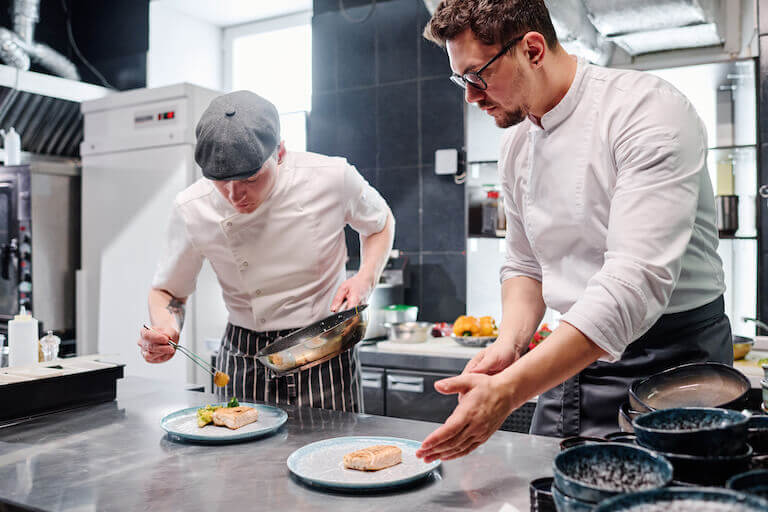
Real-world experience through hands-on industry externships can help jumpstart students’ careers.
Today, Shane splits his time between private and personal chef services. His trajectory from engineer to entrepreneur illustrates how culinary school can serve as more than just education—it becomes a bridge that helps career changers translate their existing analytical and problem-solving skills into culinary success.
“I’ve always considered myself a big student at heart,” Shane notes, and formal culinary education provided the structured learning environment he needed to make his transition both strategic and sustainable.
For professionals considering a similar leap, Shane’s story demonstrates that culinary school can be a key part of a thoughtful transition from an unsatisfying career. The combination of industry exposure, formal training, and professional networking can create a foundation that can make ambitious culinary goals—from entrepreneurship to specialized roles in emerging food sectors—genuinely achievable.

Your Strategic Action Plan: Landing a Job You’ll Love
Before You Leap—Test Your Commitment
Smart career changers don’t make the jump blindly. Instead, they often test their commitment and build relevant experience through strategic exploration:
Low-Risk Ways to Explore Culinary Interest:
- Volunteer at food festivals or charity events to experience high-volume food service
- Stage at local restaurants during busy periods to understand kitchen dynamics
- Work part-time in food service while maintaining your primary job
- Attend industry events and networking opportunities
These experiences can provide invaluable insights into whether you genuinely enjoy the reality of culinary work, not just the romanticized version.
Making the Transition Work
Gradual vs. Immediate Transition Strategies:
Gradual Approach:
- Maintain current employment while exploring culinary education
- Consider programs that offer flexibility, such as online courses with hands-on components
- Build industry connections through part-time work or volunteering
- Develop a financial cushion over 1-2 years before making the full transition
Immediate Approach:
- Best suited for those with significant financial reserves or severance packages
- Requires intensive preparation and clear post-graduation employment strategy
- May involve relocating to markets with better culinary opportunities
Building Professional Networks:
Success in the culinary industry is often influenced by relationships as much as credentials. Consider starting to build your network early through:
- Industry associations and professional organizations
- Local chef meetups and culinary events
- Social media engagement with local food professionals
- Mentorship relationships with established culinary professionals
Choosing Education Pathways:
Modern culinary education can offer unprecedented flexibility for career changers:
- Traditional on-campus programs provide immersive experience but require full-time commitment
- Online programs with hands-on industry externships allow you to maintain employment while building skills (Escoffier’s programs typically involve 15–23 hours per week, depending on program and credential)
- Continuing education and certificate programs offer targeted skill development
- Apprenticeships and on-the-job training provide immediate income while learning
Resources for Next Steps
Taking Action on Your Culinary Future:
If you’re serious about exploring culinary education, consider reaching out to Escoffier’s admissions team to discuss your goals and determine whether our programs align with your career objectives. The team can help you understand program options, financial aid opportunities, and how your professional background might translate to culinary success.
Professional Organizations for Networking:
- Research Chefs Association (for food industry careers)
- American Culinary Federation (for traditional culinary paths)
- Women’s Foodservice Forum (for leadership and networking)
- Local culinary and hospitality associations in your area
Financial Planning Resources:
Remember that financial aid may be available for those who apply and qualify. Additionally, Escoffier provides scholarship opportunities that may be suited to the needs of the career changer or adult learner.
Could a Culinary Career Be Your Recipe for Success?
The intersection of widespread corporate burnout and a thriving culinary industry creates an unprecedented opportunity for strategic career changers. But success in this transition often requires treating it as a serious business decision, not a romantic escape from corporate frustrations.
The professionals who thrive in culinary careers often share common characteristics: they leverage their existing skills, approach the transition strategically, build industry relationships before they need them, and maintain realistic expectations about timelines and financial adjustments.
Your corporate experience can be a competitive advantage that may help accelerate your culinary career in ways that others may take longer to reach. The leadership skills, business acumen, and professional maturity you’ve developed are exactly what the industry needs as it continues to evolve.
With corporate burnout at historic highs and culinary industry growth accelerating, timing favors well-prepared professionals who are ready to make a thoughtful transition.
Find out more about Escoffier’s online and on-campus programs, or reach out to our Admissions Office today for more information.

